

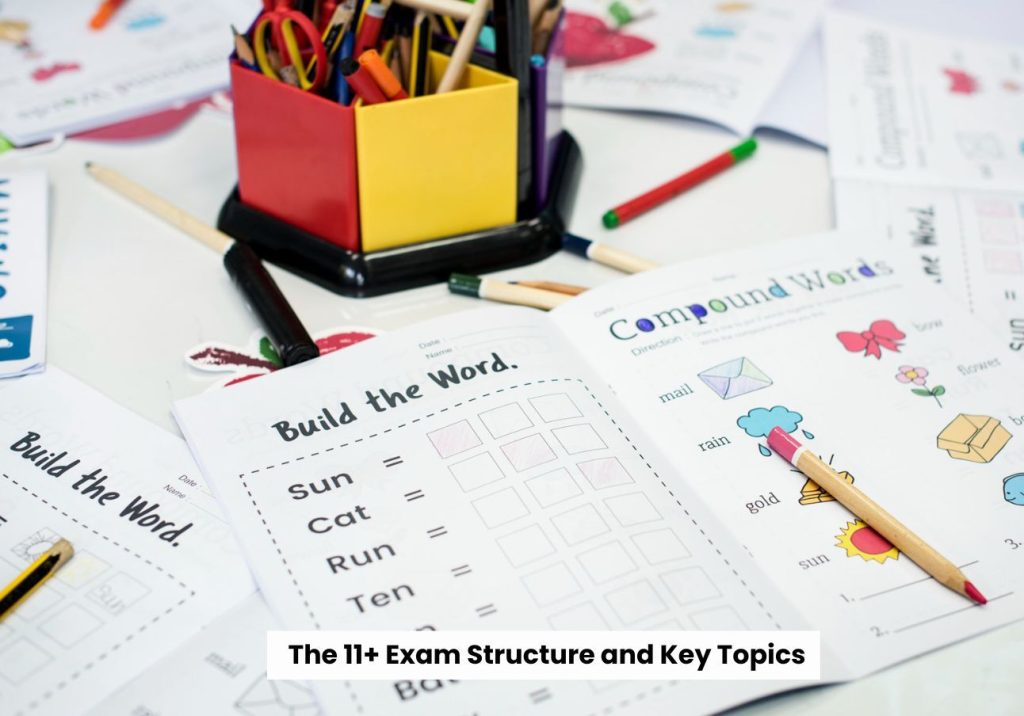
The 11+ Exam Structure and Key Topics
Ask any parent who has been through the 11 plus journey, and they will tell you the same thing the preparation is everything. The exam itself is just one day. But the weeks and months of practice that come before it are what truly determine how a child performs when it matters most. And at the heart of all that preparation are the right practice materials: topic-wise questions, past papers, and quick tests that mirror what your child will actually face on the day.
11+ Exams are not something a child can wing. They test a specific set of skills across Maths, English, Verbal Reasoning, and Non-Verbal Reasoning in a specific format, under real time pressure. Without structured, consistent practice using materials that genuinely reflect the exam, even intelligent and capable children can find themselves underprepared when they sit down for the real thing.
The good news is that the landscape of 11+ Exams preparation materials has never been richer. From free downloads to affordable online platforms, from topic-specific drill questions to full-length timed mock papers, the resources available to families today are genuinely excellent if you know what to look for and how to use them effectively.
This guide covers everything: what the 11 plus actually tests, how to choose the right papers for your child’s specific target school, how to use topic-wise questions effectively, when to introduce full past papers and quick tests, and where to find the best resources at every budget level. Whether you are just starting out or are in the final stretch of preparation, this is the guide that brings it all together.
Understanding What 11+ Exams Actually Test Before You Choose Any Resources
Before you download a single paper or click on a single practice question, take a step back and understand exactly what the 11+ Exams are testing. This is the foundation of smart preparation, and it saves families from wasting time and money on the wrong materials.
The 11 plus is not a single, uniform exam. It varies significantly by region and by school type. Here is what you need to know:
- Grammar school entrance exam papers typically cover four main subject areas:
- Maths number operations, fractions, decimals, percentages, algebra, shape, space, data, and word problems
- English reading comprehension, vocabulary, grammar, punctuation, and sometimes creative writing
- Verbal Reasoning word patterns, analogies, codes, missing letters, and language logic
- Non-Verbal Reasoning shapes sequences, pattern recognition, reflections, rotations, and spatial thinking
GL Assessment used by grammar schools in Kent, Buckinghamshire, Hertfordshire, Essex, Lincolnshire, and many other areas. GL assessment 11 plus papers test all four subjects separately, with maths and English as standalone papers.
CEM (Centre for Evaluation and Monitoring) is used by schools in areas including Durham, Birmingham, and Bucks. CEM 11 plus practice tests use a blended format that combines verbal reasoning with English and numerical reasoning with maths in ways that can feel less predictable.
Some independent schools use ISEB common pre-test practice papers, while others set their own papers entirely. Always check the specific exam format for your child’s target school before purchasing any resources. Practising with the wrong format is one of the most common and costly preparation mistakes.
Why Topic-Wise Questions Are the Most Powerful Starting Point for 11+ Preparation
When most parents think about 11 plus preparation, they immediately think about past papers. And past papers are absolutely important, but they are not the right starting point. That honour belongs to 11 plus topic-wise questions.
Here is why. A full 11 plus paper covers many topics simultaneously. When a child sits a full paper and gets something wrong, it is often hard to pinpoint exactly why it was the specific concept? The question format? Time pressure? A careless reading error?
Topic-wise questions solve this problem by isolating one concept at a time. Your child practises 11 plus algebra questions in a dedicated set, then moves to 11 plus fractions practice test questions, then works through 11 plus geometry worksheets, each one building mastery of a single topic before combining them in full papers.
This approach delivers several important benefits:
- Faster improvement targeted practice on specific weaknesses produces more improvement per hour than general paper sitting
- Genuine understanding working through one topic deeply builds real knowledge, not just pattern recognition
- Clearer tracking you can see exactly which topics your child has mastered and which still need work
- Reduced overwhelm for children who find the full paper daunting, topic-wise questions provide an accessible, confidence-building entry point
11 plus maths topic tests are particularly valuable in this respect. Breaking maths down into arithmetic, algebra, fractions, geometry, and word problems and working through each area systematically builds the kind of broad, flexible maths knowledge that the real exam demands.
The ideal preparation journey starts with topic-wise questions, uses them to build mastery and identify gaps, and then transitions to full papers once the foundational knowledge is solid.
A Complete Subject-by-Subject Guide to Topic-Wise 11+ Practice
Let’s break down exactly what topic-wise practice should cover in each of the four main subject areas.
Mastering Maths: From Arithmetic to Algebra and Everything in Between
Maths is the subject where topic-wise practice delivers the most dramatic results. The 11 plus maths papers cover a wide range of topics, and children who have worked through each one systematically are far better prepared than those who have only ever sat full mixed papers.
Key topic areas for maths preparation:
Number and Arithmetic
- 11 plus arithmetic practice questions the four operations, mental maths, order of operations
- Place value, rounding, and estimation
- Factors, multiples, primes, and square numbers
Fractions, Decimals, and Percentages
- 11 plus fractions practice test work adding, subtracting, multiplying, dividing fractions
- Converting between fractions, decimals, and percentages
- Finding percentages of amounts and percentage increase/decrease
Algebra and Sequences
- 11 plus algebra questions simple equations, function machines, algebraic substitution
- Number sequences and pattern rules
- Writing and solving simple equations
Shape and Space
- 11 plus geometry worksheets area, perimeter, angles, properties of 2D and 3D shapes
- Coordinates and transformations
- Volume and surface area at the appropriate level
Data and Problem Solving
- 11 plus word problems practice the most common source of lost marks in maths
- Reading and interpreting graphs, charts, and tables
Multi-step problems that require planning before calculating
Use 11 plus maths revision questions in each of these areas systematically before combining them in full paper practice. The improvement in accuracy and speed that this approach produces is genuinely significant.
Building English Skills: Comprehension, Grammar, and Vocabulary
English preparation covers a broader range of skills than many parents initially realise. Strong performance requires both reading comprehension ability and solid grammar and language knowledge.
Reading Comprehension
- 11 plus comprehension practice papers the core of English preparation
- 11 plus English comprehension questions that test literal understanding, inference, deduction, and vocabulary in context
- Practice with a wide variety of text types fiction, non-fiction, poetry, and information texts
Grammar and Punctuation
- 11 plus English grammar practice parts of speech, sentence structure, punctuation rules
- Common grammar errors and how to avoid them
- Punctuation commas, apostrophes, speech marks, colons, and semicolons at the right level
Vocabulary
- 11 plus vocabulary questions, synonyms, antonyms, words in context
- Building a wide word bank through daily reading
- Prefixes, suffixes, and word roots as a vocabulary expansion strategy
11+ English practice papers that combine all of these elements are the final step, but topic-wise English work in comprehension, grammar, and vocabulary should come first.
Children who read widely and regularly books, magazines, and quality news websites for children build English skills naturally and continuously. No resource replaces daily reading as a vocabulary and comprehension development tool.
Verbal Reasoning: The Subject That Rewards Systematic Practice Most
Verbal reasoning covers the widest range of distinct question types of any 11 plus subject. This can feel overwhelming until you approach it topic by topic.
Key question types for 11 plus verbal reasoning practice tests:
- Synonyms and antonyms: finding words with similar or opposite meanings
- 11 plus analogies practice, identifying the relationship between pairs of words
- Codes and ciphers are letter and number codes that follow a consistent rule
- Missing letters and words, completing sequences, or finding hidden words
11+ verbal reasoning worksheets covering word connections, compound words, and word classifications
The key with verbal reasoning is breadth. There are typically 21 distinct question types, and children need to be familiar with all of them. Work through two or three types per session rather than trying to cover everything at once. Each question type improves rapidly with focused repetition.
11 plus verbal reasoning practice tests that mix multiple question types are excellent once individual types have been practised in isolation. This mirrors what the real exam looks like: a mixture of familiar formats that a well-prepared child handles with confidence.
Non-Verbal Reasoning: Visual Thinking Skills That Improve Faster Than Any Other Area
Non-verbal reasoning is the subject that most parents know least about and the one that responds most dramatically to even a small amount of focused practice. Children who have never encountered these question types before are often surprised by how unfamiliar they feel. But children who have worked through them systematically find them straightforward.
Key areas for 11 plus non-verbal reasoning questions:
- Shape sequences identifying the rule governing a series of shapes and predicting the next
- 11 plus pattern recognition tests, spotting the pattern in a matrix or grid
- Reflections and rotations: understanding how shapes change when flipped or turned
- Odd one out: identifying which shape does not belong in a group
- 11 plus spatial reasoning questions, nets of 3D shapes, cube views, and 3D visualisation
- Analogies apply the same transformation to a new pair of shapes
Visual, hands-on practice is particularly effective for non-verbal reasoning. Some children find it helpful to physically cut out and manipulate shapes before working through paper-based questions. This concrete approach builds the spatial thinking that the questions test.
Past Papers: When to Introduce Them and How to Use Them Effectively
Past papers are the gold standard of 11 plus preparation but only when introduced at the right time and used in the right way. Too early and they discourage children who have not yet built the foundational knowledge. Too late and children miss the opportunity to develop the exam stamina and time management skills they need.
11 plus past papers download resources are available from multiple sources, and using them effectively requires a clear approach.
When to Start Past Papers:
- Begin topic-wise preparation first at least two to three months of topic-based work before introducing full papers
- Introduce 11 plus sample questions year 5 style shorter mixed practice before moving to full papers
- Start full past papers around three to four months before the real exam
- From six to eight weeks before the exam, introduce weekly full timed mock sittings
How to Use Past Papers Effectively:
- Sit every paper under realistic conditions proper timer, quiet desk, no interruptions
- Mark using a detailed mark scheme 11+ papers with mark schemes are essential for accurate marking and useful feedback
- Review every wrong answer together immediately after marking
- Track scores across multiple papers and look for the trend over time, not just individual results
- Use wrong answers to identify which topics need more focused practice before the next paper
eleven plus exam papers PDF versions are particularly convenient for home use they can be printed at home, which gives a more authentic exam experience than working on a screen.
The Role of Quick Tests in Building Speed and Confidence
Alongside topic-wise questions and full past papers, 11 plus quick tests online and short printed tests play a vital and often underestimated role in preparation. Quick tests are typically 10 to 20 questions, completed in 10 to 15 minutes short enough to fit into any day, but focused enough to build genuine skills.
Here is why 11 plus quick tests online and short timed drills are so valuable:
- They build speed doing 20 arithmetic questions in 10 minutes trains mental calculation speed in a way that untimed practice simply cannot
- They maintain momentum a short daily quick test keeps the preparation habit alive on days when a full paper is not practical
- They build confidence completing a short test successfully every day creates a positive association with exam practice that supports motivation
- They isolate specific skills a quick test focused on fractions, or sequences, or comprehension inference questions, develops that skill far more efficiently than a full mixed paper
11 plus timed practice papers at full length are the weekly centrepiece of preparation. Quick tests are the daily maintenance that keeps skills sharp between full paper sittings. Both are essential they serve different purposes and work best together.
Choosing the Right Resources: GL, CEM, Bond, CGP, and More
The 11 plus preparation market is large and varied. Knowing which resources are worth your time and money and which to prioritise makes a significant difference to both your budget and your preparation quality.
GL Assessment 11 Plus Papers
For children targeting GL schools, GL assessment 11 plus papers in the authentic format are essential. These include separate maths and English papers alongside verbal and non-verbal reasoning. The GL format is well-represented in published revision books and online platforms.
CEM 11 Plus Practice Tests
CEM preparation requires a slightly different approach, as the blended format is less predictable. CEM 11 plus practice tests that specifically replicate the CEM style including the combined verbal/comprehension and numerical/reasoning elements are important for children targeting CEM schools.
Bond 11 Plus Practice Papers
Bond 11 plus practice papers are among the most widely recommended published resources for 11 plus preparation. The Bond series covers all four subjects across multiple difficulty levels, making it easy to match the resource to your child’s current level and progress upward as skills improve. Bond papers are well-structured, accurately pitched, and widely available from bookshops and online.
CGP 11 Plus Practice Tests
CGP 11 plus practice tests are another highly trusted resource, particularly for their clear explanations and structured approach to topic revision. CGP books often include helpful summaries of key concepts alongside practice questions, making them particularly useful for children who need more explanation before attempting practice questions independently.
KS2 11 Plus Revision Papers
KS2 11 plus revision papers bridge the gap between standard primary school work and the specific demands of the 11 plus. They are particularly useful in the early stages of preparation when children are building foundational knowledge before moving to exam-specific materials.
ISEB and Independent School Papers
For children applying to independent schools, ISEB common pre-test practice papers and independent school 11 plus past papers are essential. The ISEB Common Pre-Test is used by many independent schools as a standardised initial assessment, and dedicated preparation materials for this specific test are widely available.
—
How to Build a Complete Practice Schedule Using Topic Tests, Past Papers, and Quick Tests Together
The most effective 11 plus preparation combines all three types of practice topic-wise questions, full past papers, and quick tests in a structured weekly routine. Here is how to put it all together.
Sample Weekly Routine (3 to 6 Months Before the Exam):
- Monday: Topic-wise maths 30 minutes focused on one topic (e.g., fractions or word problems)
- Tuesday: Topic-wise English 30 minutes comprehension practice with one passage and questions
- Wednesday: Verbal reasoning topic work 30 minutes on two or three specific question types
- Thursday: Non-verbal reasoning 30 minutes on specific pattern or sequence question types
- Friday: Quick test, 15-minute timed mixed test covering recent topics
- Weekend: Full-time mock exam (once per week in the final three to four months)
Sample Weekly Routine (Final 6 to 8 Weeks Before the Exam):
Monday to Thursday: Short topic-specific review sessions targeting the weakest areas from the previous week’s mock
Friday: Quick test to check improvement in targeted areas
Weekend: Full-time mock exam under realistic conditions, followed by a thorough review
11 plus mixed topic tests are a useful bridge between topic-specific work and full papers. They combine several topics in one sitting without the full length and pressure of a complete mock exam.
Online 11 plus practice questions are a convenient option for quick daily practice, particularly for children who respond well to the immediate feedback that online platforms provide.
Online vs Printed Resources: Which Format Works Best for 11+ Preparation?
Both online and printed resources have genuine strengths, and the most effective preparation typically uses both. Here is a clear breakdown.
Printed Papers Strengths:
- Closest replication of the real exam experience (the actual exam is paper-based)
- No screen fatigue during longer sitting sessions
- Easy to annotate and show working
- 11 plus timed practice papers in printed format feel more authentic than screen-based versions
Online Resources Strengths:
- Instant marking and feedback without parent involvement
- Progress tracking across multiple sessions
- Convenient for daily short practice 11 plus quick tests online work particularly well in online format
- Wide variety of 11 plus exam topics UK covered on good platforms
- Accessible at any time, on any device, making daily practice easier to maintain
The Ideal Combination:
Use online platforms for daily topic-specific drills, quick tests, and instant feedback. Use printed papers for weekly full mock sittings and any practice that benefits from the authentic paper-based experience. This combination maximises the strengths of both formats.
11 plus mock test online resources have become increasingly sophisticated and are now a genuine and valuable part of any preparation plan not a substitute for real paper practice, but a powerful complement to it.
The Importance of Mark Schemes and Detailed Feedback in 11+ Preparation
One of the most important and most frequently overlooked aspects of 11 plus preparation is what happens after a paper is sat. Simply sitting papers and noting the score is not preparation. Real preparation is what happens when you sit down with your child and work through every wrong answer together.
11+ papers with mark schemes are essential for accurate marking, but the mark scheme is only the starting point. Effective review involves:
Understanding exactly why each wrong answer was wrong
Identifying whether the error came from a knowledge gap, a misread question, or a time management issue
Noting which topic types keep appearing in wrong answers across multiple papers
Using this information to adjust the focus of subsequent topic-wise practice sessions
Children who review their papers thoroughly and understand their errors consistently improve faster than those who simply sit more papers without reflection. The review process is where genuine learning happens and it costs nothing but time and attention.
11+ entrance exam revision is most effective when it is a cycle: practise, sit, review, adjust, practise again. Every paper your child sits should feed back into the next stage of preparation, making each subsequent session more targeted and more effective.
How Quest for Exam Gives Your Child the Complete 11+ Practice Resource in One Place
At Quest for Exam, we understand exactly what families preparing for 11+ Exams need, and we have built a platform that delivers all of it, in one place, at prices that work for real families.
Here is what Quest for Exam offers:
- Topic-wise question banks covering every area of the 11 plus syllabus, Maths, English, Verbal Reasoning, and Non-Verbal Reasoning, are organised clearly by topic and difficulty level, so your child always practises exactly what they need most.
- 11 plus past papers download access in GL and other formats, full-length authentic papers your child can sit, time, and review in exactly the conditions of the real exam.
- 11 plus quick tests online for daily short practice, 10 to 20 minute focused sessions that maintain momentum and build speed between full paper sittings.
- Detailed mark schemes with full answer explanations for every paper and question set, not just the right answer, but the complete reasoning behind it.
- 11 plus mock test online in authentic exam conditions, full timed sittings with immediate scoring and performance breakdowns by topic.
- Grammar school 11 plus preparation resources specifically tailored to GL and other exam formats, so your child is always practising in the right format for their specific target school.
- Progress tracking that shows clearly where improvement is happening and where gaps remain, giving you precise, actionable information to guide each week’s preparation.
- Selective school entrance test papers for a range of school types, GL, CEM, and independent school formats, all available in one place.
- Affordable 11 plus exam preparation UK pricing that makes quality preparation accessible to every family, not just those with the largest budgets.
- Regular resource updates, ensuring your child always has access to fresh, varied practice material never just repeating the same questions over and over
Whether your child is working through their first 11 plus topic wise questions or sitting their final mock before the real exam, Quest for Exam has exactly the right resource at exactly the right moment in their preparation journey.
Visit Quest for Exam today and explore the complete range of topic-wise questions, past papers, and quick tests because every child deserves preparation that is thorough, well-structured, and genuinely effective.
FAQs
When should my child start using past papers in their 11+ preparation?
Introduce full past papers around three to four months before the real exam, after a solid foundation of topic-wise practice has been established. Before that, use topic-specific tests and shorter mixed practice to build the foundational knowledge that full papers require.
How many past papers should my child sit before the 11+ exam?
Aim for six to ten full past papers across your preparation period, alongside regular, shorter topic-wise tests and quick tests. In the final six to eight weeks, weekly full mock sittings are ideal preparation.
What is the difference between GL and CEM 11+ papers?
GL Assessment papers test each subject separately with dedicated maths, English, verbal reasoning, and non-verbal reasoning papers. CEM papers blend subjects, verbal reasoning with English, and numerical reasoning with maths in a combined format that can feel less predictable. Always confirm which format your target school uses before purchasing resources.
Are online practice questions as effective as printed papers for 11+ preparation?
Both have genuine value. Printed papers more closely replicate the real exam experience. Online resources provide instant feedback and convenient daily access. The strongest preparation combines both formats online for daily topic practice, printed for weekly full mock sittings.
How long should each topic-wise practice session last?
30 to 45 minutes per session is ideal for most Year 5 children. Keep sessions focused on one or two specific topic areas rather than mixing too many topics in a single sitting. Consistent short sessions produce better results than occasional long ones.
What should I do if my child keeps making the same mistakes across multiple papers?
This is a signal that the underlying concept has not been fully understood. Return to topic-wise questions for that specific area, work through them at a slower pace, and focus on understanding why each answer is correct before moving back to mixed practice.
How important are mark schemes when reviewing 11+ papers?
Extremely important. Accurate marking requires detailed mark schemes, and real learning from wrong answers requires understanding the correct reasoning not just knowing what the right answer was. Always use papers that come with full, detailed mark schemes.
Is it better to use Bond or CGP resources for 11+ preparation?
Both are excellent and widely trusted. Bond papers are particularly good for progressive difficulty and subject coverage. CGP resources are particularly strong for topic explanation alongside practice. Many families use both CGP for building topic knowledge and Bond for structured paper practice.